
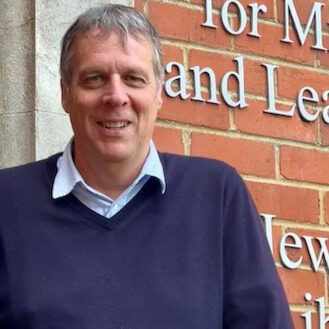
Geoff New
Graduation Leaving Decade:
I arrived at Knox Theological Hall at the beginning of 1996 having completed an undergraduate degree at Laidlaw College (formerly Bible College of NZ). I had little to no understanding of what to expect in terms of the training programme.
Upon arriving, I discovered this was the year that the relationship with Otago University had been dissolved, and there was a mixed student body. There were those who were finishing their studies under the previous relationship between the Theological Hall and Otago University; and those commencing the new form of training under the newly named School of Ministry. I was in the latter group and there were only three of us: Mark Johnston, Mark Keown, and me.
It was evident too that there was significant grief among the staff and student body with the ending of the relationship between the Theological Hall and Otago University.
The training was Dunedin-based and students housed in homes owned by Knox in the suburb in the hills above Knox College; Ōpoho. There was a strong student community with the vibrancy of young families enhancing the culture.
The principal at the time was Rev Dr Simon Rae. The person heading up the new training was Rev Dr Milton Coleman (Uniting Church, Australia), and he was not due to arrive at the School of Ministry until the second term. This new form of training was a two-year graduate programme which focused on reflective-practice. Other faculty at the time included Professor Peter Matheson, Professor Alistair Rae, Dr Mary Huie-Jolly, and Dr Susan Weinsten.
Initially, the training was self-directed under the guidance and wisdom of Simon Rae. When Milton arrived, he continued to allow a form of training which was exploratory, engaging, and experience-based. Milton was highly experienced in reflective-practice/action-research. He was extraordinarily good at what he did.
The training included a unit of Clinical Pastoral Education at Dunedin Hospital under Revs Storm Swain and Chris Elliot. We would be placed in various local ministry settings, and these would be supplemented with classroom and workshop engagements. Overall, I found the two years training at the School of Ministry deeply formative and energising. The training that was developed was intentional, focused, and best practice. The model was the precursor to the current internship training.
My time at the School of Ministry proved to be the best years of training I had encountered.