
The Call of Matthew/The Call of You
By Geoff New
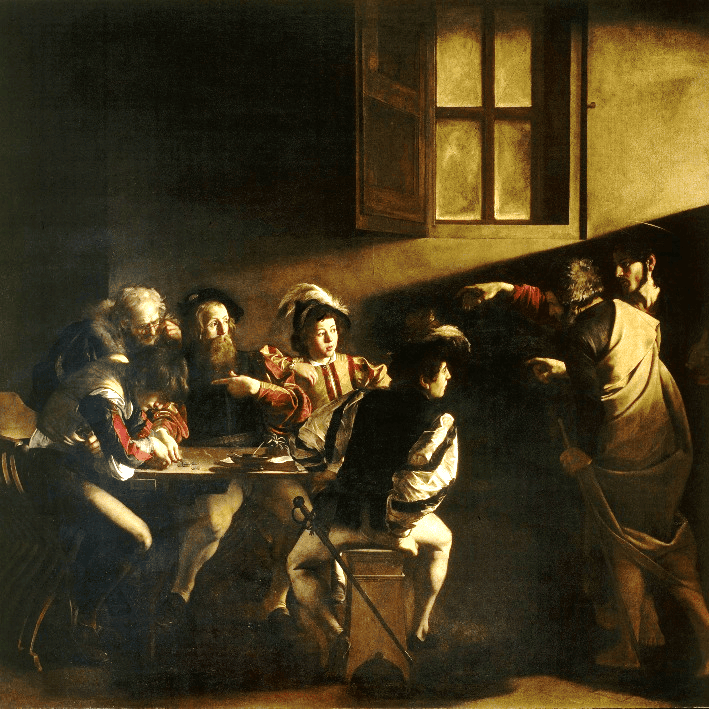
Over recent times, in a surprising variety of settings, I have introduced a painting which has proven to be a silent sermon which says much. On each occasion, it has not failed to impact those who listen to its message. The painting is The Calling of St Matthew (1599-1600) by Caravaggio. A wonderful book by Juliet Benner (Contemplative Vision: A Guide to Christian Art and Prayer) helpfully provides guidance in discerning the invitations and challenges it offers.
Michelangelo Merisi da Caravaggio was an artist who lived mainly in Rome in the late sixteenth and early seventeenth centuries. He is more commonly referred to as simply Caravaggio, and his paintings are some of most beautiful sermons I have encountered. His paintings – with their symbolism, meaningful details, and especially Caravaggio’s development of a technique of using light and dark – speak profoundly and powerfully.
So first, let’s consider the bible passage this “sermon” is based on:
Luke 5:27–32 (NIV)
27 After this, Jesus went out and saw a tax collector by the name of Levi sitting at his tax booth. “Follow me,” Jesus said to him, 28 and Levi got up, left everything and followed him.29 Then Levi held a great banquet for Jesus at his house, and a large crowd of tax collectors and others were eating with them. 30 But the Pharisees and the teachers of the law who belonged to their sect complained to his disciples, “Why do you eat and drink with tax collectors and sinners?”
31 Jesus answered them, “It is not the healthy who need a doctor, but the sick. 32 I have not come to call the righteous, but sinners to repentance.”
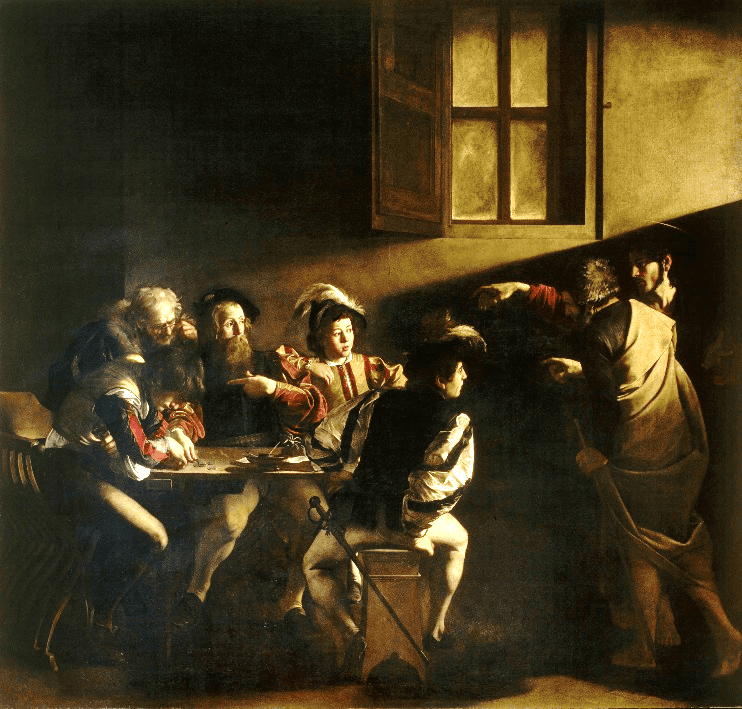
- The painting is divided into two unequal halves; the left is a horizontal rectangle (life as it was in Caravaggio’s day) and the right is a vertical rectangle (life as it was in Jesus’s day). The five at the table are dressed in rich clothing of the day, while Jesus and Peter are in simple 1st century Palestinian clothing. Here, Caravaggio is illustrating that Jesus and his call span all ages, times, and generations. Jesus’s outstretched hand bridges the two contexts.
- Caravaggio’s interplay of light and dark conveys spiritual truths concerning inner darkness and inner light. The five men at the table are illuminated by light that comes from somewhere other than the window; the light is divine in nature and illuminates the darkness.
- The five men represent the stages of life: from young, middle–aged, to elderly. Their attention and focus to what is taking place in the room is varied and instructive. Those on the right, including Matthew, are aware of Jesus’s presence. The two men on the left are totally engrossed in the revenue generated by the taxes they have extracted from the community. They are oblivious that the Light of the World has entered the room.
- Jesus and Peter are emerging from the darkness, with Jesus is in the darkest part of the room. He is almost hidden in the dark. A faint halo identifies him. His hand of invitation and call is positioned under the cross of the window. His hand is illuminated by the light and his red sleeve, and Jesus’s feet are tending to face in the direction of leaving the room.
I once received helpful advice from an American minister I met while on study leave overseas: “Always look for the feet in a Caravaggio painting. He is trying to tell you something through the way he paints them.” - Matthew’s gaze is transfixed on Jesus; the objects, people, and gains of his trade on/at the table are now secondary. Matthew is yet to obey the call; the painting captures the moment of first hearing the call of Christ. We see him at the moment of decision amid the play of light and darkness. Indeed the moment-in-time, just before Matthew’s decision, is emphasised in that his right hand is frozen over the table, still holding some of the money. His left-hand meanwhile is pointing to himself as he absorbs the invitation and challenge of Christ.
- As Jesus points, Matthew is unsure if Jesus means him or the other two younger men on his left. Matthew is pointing to himself; “Who, me?”
He is astonished.
The two younger men are in different states of interest and response. The one with his back to the viewer has one hand on the bench he is seated on, as if he is about to stand and follow. The angle of his sword directs our eye back towards Matthew; perhaps by way of reminder insofar that we know what Matthew decides to do.
Questions for Life
As you view this “sermon” of Caravaggio’s – Juliet Benner crafts insightful and incisive questions for us:
- What have you been preoccupied with when Jesus enters your “dark room”? Where has your focus been? What is on your table in front of you that engrosses you? Have you even noticed Jesus’s presence?
- What is it like for you to consider the full light of God shining upon you? What is illuminated when God’s light falls on your life? Is God’s light welcomed or repelled?
- What is it like to hear the voice of Jesus calling you to be with him and to continue to journey with him?
- Of the five different postures at the table, which one best represents you currently? Why?
- In what way are you like Matthew as Caravaggio depicts him: “Who, me?”
Why? - Is there anything that keeps you from deciding to follow Jesus?
What would you have to abandon to more fully follow Jesus? - How aware of you of Jesus’s voice and presence in the midst of your present circumstances – calling you to turn and be transformed?
How do you respond?