
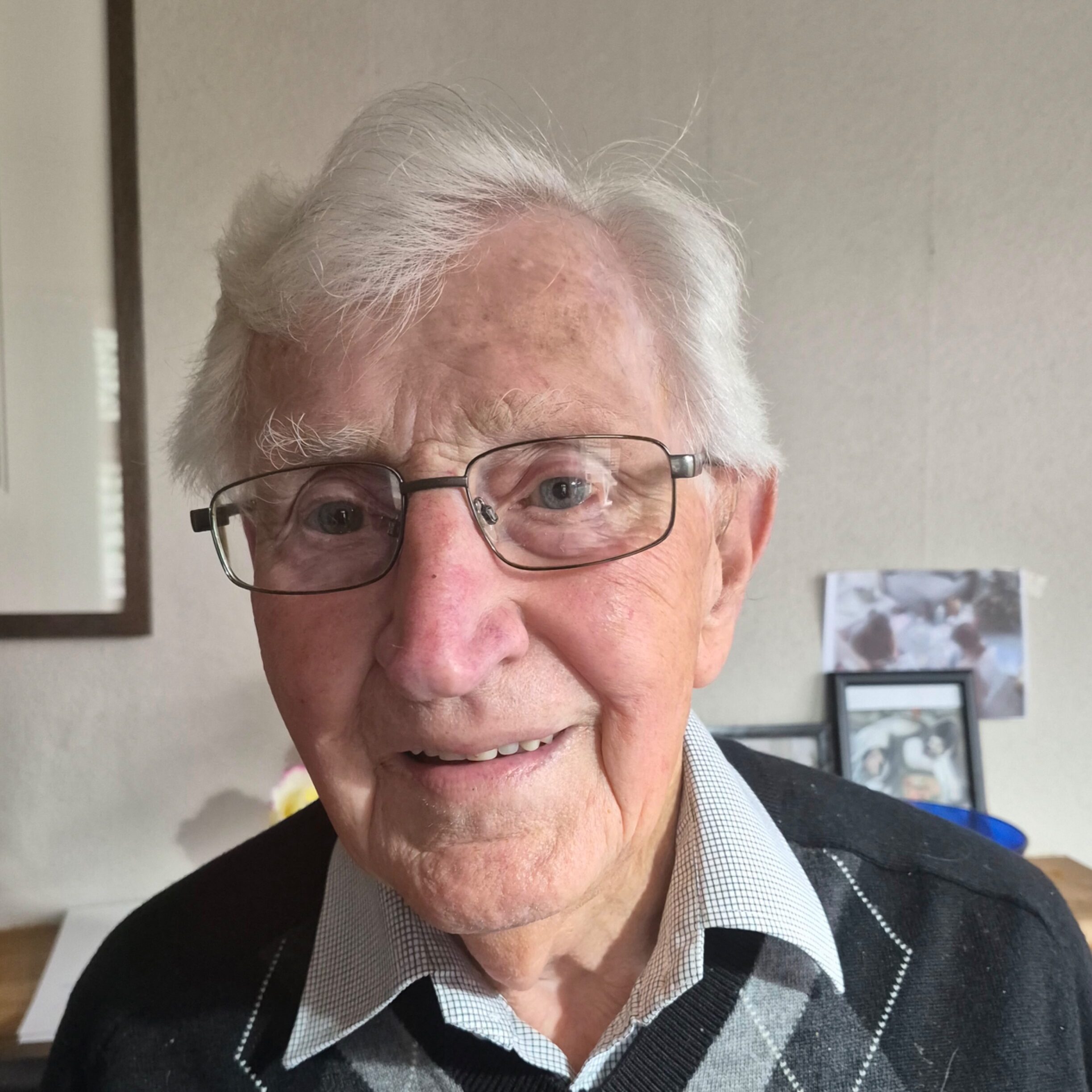
Maurice Andrew
Graduation Leaving Decade: 1950
Years at Knox Theological Hall / KCML: 1954 - 1956
I was drawn to train at the Theological Hall (TH) because I had known a call as a teenager, influenced by my parents who had been Salvation Army officers before my father became a Presbyterian minister. An experience at a Knox social event still makes me smile: I was listening to a conversation between, Profs Allen and Rex. The latter said that I was studying German so I could read Rudolf Bultmann in the original. The two began arguing about demythologisation, and I left them to it.
Since leaving Knox, may journey has taken me to Germany where at Heidelberg I was supervised by Prof. Gerhard von Rad and graduated Doctor of Theology. On leaving, von Rad said, “How wonderful to return home with a doctor hat and with a German wife.” (Gisela) She and I then journeyed to the parish of Ngaio where our first two children were born. I consciously drew on my training at Knox to prepare and lead services and to do parish visiting. One elder once spoke of “your style of leadership.” I am sure that was because of the kind of training I had at Knox.
Gisela’s parents had not, however, seen their grandchildren, so the next stage of our journey was back to Germany, where I also obtained a position of assistant lecturer at the Church College in Wuppertal. It was living in together and I’m sure that my experience living at Knox College and studying at the TH was the reason why I knew how to give pastoral care to the German students. Both students and staff remarked on it, and the latter encouraged me to apply for a lectureship at the University of Ibadan in Nigeria.
So that was big journey for the whole family. Nigeria was a culture shock. It was a master/servant society, and I had to adapt my leadership style while not really enjoying it. A New Zealand friend, Peter McKenzie, who also had a German wife, Renate, was big help to me. We had to accept our authority but exercise it in an egalitarian way. We were obliged to work with the difficulties that the students were going through: military coups in which some of their different ethnicities were involved. It was a challenge for our belief as Christians when ultimately civil war commenced.
Despite all this, I managed to finish and get my first book published: “The Ten Commandments in Recent Research” (with J.J. Stamm). The communal background to the commandments strengthened my belief in the Christian community.
It was part of Gisela’s and my journey that we realised we had to settle somewhere. Rather inconsequentially, I applied for a lectureship in German at Massey University in Palmerston North. The fact that I kept up my German at the TH and in Heidelberg may have helped in my getting the position. It did not prevent me resuming my relation with the Presbyterian Church Of NZ. I was a member of a local parish and of Presbytery and also convener of its students committee.
This was not, however, the place where I wanted the journey to end. When Lloyd Geering become the first professor of Religious Studies at Victoria University, I knew that my real role in ministry, leadership and service had come, and over-confidently expected to get the position of Professor of Old Testament Studies, but I did. Apart from the lectures, the important element after Ibadan and Palmerston north were the daily chapel services; they broadened my faith and encouraged my leadership. The students here too appreciated my pastoral care. The need for that was based in the time when I was student myself in the TH.
The first few years were mainly occupied with rewriting and extending the lectures I had given in Ibadan . After a conference in Australia, however, where many were talking of Australian theology, I realised that the same thing could apply in New Zealand, and I wrote “The Old Testament and New Zealand Theology”. Writing it and hearing the response deepened both my thought and belief on New Zealand soil. (Later, at an international conference, I did hear some participants joking about there being a New Zealand theology!)
After my first overseas study leave, I wrote the booklet Little Things Count: Journal of a New Zealander Overseas. It was the book that gained the most popular response. The next book, however, developed directly out my exegesis classes and the encouraging response from students: “Responsibility and Restoration: The Course of the Book of Ezekiel”. This response was reflected in my last period teaching at the TH: Responding in Community. Reforming Religion in Aotearoa/New Zealand.
There was much else in the TH before this. 1976 was the centenary year, and we held a colloquium. My former school and student friend, George Armstrong, gave a presentation on demonstrations he had arranged in Auckland: it was vigorous theology on the streets, New Zealand theology in action. After the final service Frank Nichol, the principal, gave a vigorous sigh of relief. I had not realised how deeply he had been involved.
I realised it myself when I was appointed principal in 1985. I had been reticent, but accepted the role positively when I was appointed I think I did have a gift of natural leadership. Beth Nichol, the librarian, said, “Even people who know you are surprised, Maurice.” But it did not last. I was discouraged by the negative attitude of the Theological Hall Committee to what we were doing, and I did not have the ability to deal with a strong group of students who were dissatisfied in a complex way. I was no longer a leader, and I was not getting satisfaction from my academic work. I was sick of it. I retired.
It did not, however, end my relation with the TH; it went too deep for that. The journey went on. I found myself quite naturally attending the weekly community hour now held with speakers discussion, worship and talk over lunch. It helped that it connected with finishing my book on “Responding in Community” and that in the autobiography I wrote (“Set in a Long Place: A Life from North to South”) important elements of it were both being a student and a teacher in the TH. It kept me being brought back to my ministry. I was also able to continue what had been an important part of my work in the TH: writing. The foundations of my life and thought were still present and I became more conscious of the life between Maori and Pakeha and other peoples. These matters were expressed in further books: “The Old Testament in Aotearoa New Zealand”, and “God with Us in Particular Spheres of Ordinary Life”.
My journey continues in thought, belief, and possibly in some kind of indirect leadership.